
BMW Isetta 250 export '57
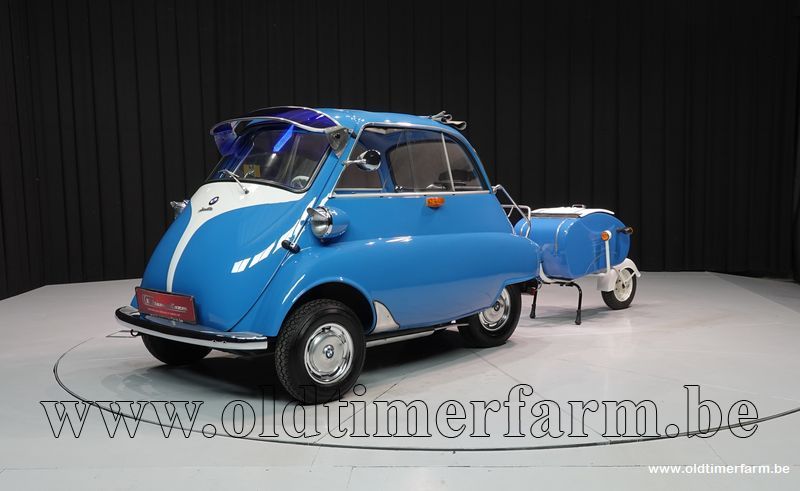
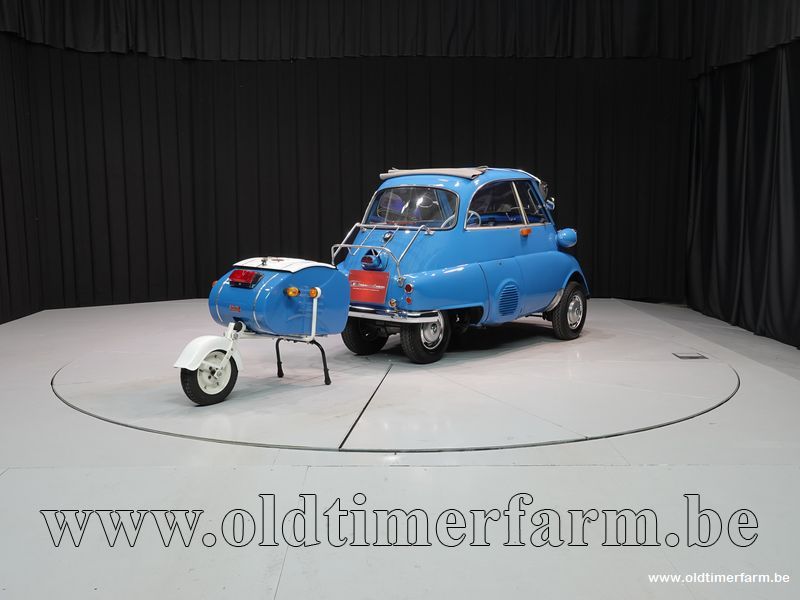
- Belgian documents
- With trailer
- 4 gears
- 1 cylinder
- 12hp
The Isetta is an Italian-designed microcar built under license in a number of different countries, including Argentina, Spain, Belgium, France, Brazil,Germany, and the United Kingdom. Because of its egg shape, it became known as a bubble car, a name also given to other similar vehicles.
In 1955, the BMW Isetta became the world's first mass-production car to achieve a fuel consumption of 3 L/100 km. It was the top-selling single-cylinder car in the world, with 161,728 units sold. The name Isetta is the diminutive of Iso. BMW made the Isetta its own. They redesigned the powerplant around a BMW one-cylinder, four-stroke, 247 cc motorcycle engine which generated 9 kW (12 hp). Although the major elements of the Italian design remained intact, BMW re-engineered much of the car, so much so that none of the parts between a BMW Isetta Moto Coupe and an Iso Isetta are interchangeable.[22] The first BMW Isetta appeared in April 1955. In May 1962, three years after launching the conventionally modern-looking BMW 700, BMW ceased production of Isettas. A total of 161,728 units had been built.
The Isetta 250 used the engine of the morocycle R25/3. The advantage of that microcar : it could be driven with a motorcycle license in Germany.. The top speed of the Isetta 250 was rated as 85 km/h (53 mph).
- Specifications
- Bodywork
- Length : cm/in: 225/88.6
- Width : cm/in: 134/52.8
- Height : cm/in: 132/52
- Wheelbase : cm/in : 150/59.1
- Weight: kg/lb : 353/778
- Mechanics.
- Displacement : 1 two-stroke cylinder 247 cc , rear wheel drive
- Valve gear : 0
- Fuel system : 1 carburettor
- Gearbox : 4-speed manual
- Driving wheels : rear wheel drive
- Maximum power : 12 bhp at 5800 rpm